Cooking, 7 min read
How to scale a recipe up or down (without ruining it)
The one formula for scaling any recipe, a cheat sheet for halving awkward measurements, and the things that don't scale: salt, pans, bake times.
To scale a recipe, divide the number of servings you want by the number the recipe makes. That number is your conversion factor. Multiply every ingredient by it, then adjust the few things that don't scale in a straight line: seasoning, pan size, and cooking time.
The rest of this post covers the awkward bits: halving a third of a cup, doubled chili that's too hot, and cakes that come out raw in the middle.
The formula
Conversion factor = servings you want ÷ servings the recipe makes
- Recipe serves 4, you want 6: 6 ÷ 4 = 1.5
- Recipe serves 4, you want 2: 2 ÷ 4 = 0.5
- Recipe serves 6, you want 8: 8 ÷ 6 = 1.33
Write the factor at the top of the recipe and rewrite every quantity before you start. Doing math with a whisk in your hand is how you end up with double the flour and single the butter.
A worked example
Say you have a chicken curry that serves 4 and you're feeding 6. The factor is 1.5.
| Original (serves 4) | × 1.5 | Scaled (serves 6) |
|---|---|---|
| 1 lb (450 g) chicken thighs | 1.5 | 1½ lb (680 g) |
| 1 onion | 1.5 | 1 large onion, or 1½ medium |
| 2 tsp ground cumin | 1.5 | 3 tsp = 1 tbsp |
| 1 can (14 oz) coconut milk | 1.5 | 1½ cans (21 oz) |
| ⅓ cup (80 ml) water | 1.5 | ½ cup (120 ml) |
| 1 tsp salt | 1.5 | 1½ tsp, then taste |
Two things worth noticing. First, some numbers round off naturally: 3 tsp is exactly 1 tbsp, and 1.5 × ⅓ cup is exactly ½ cup. Second, "1½ onions" is fine in a curry. Nobody can tell. Round whole items like onions and garlic cloves to whatever's sensible; save the precision for baking.
Cheat sheet for awkward measurements
The math is easy until you have to halve ⅓ cup. These are the conversions that make it work:
- 3 teaspoons = 1 tablespoon
- 4 tablespoons = ¼ cup
- 16 tablespoons = 1 cup
- ⅓ cup = 5 tablespoons + 1 teaspoon
And the ones you'll actually reach for:
| Amount | Halved | Doubled |
|---|---|---|
| 1 cup | ½ cup | 2 cups |
| ¾ cup | 6 tbsp | 1½ cups |
| ⅔ cup | ⅓ cup | 1⅓ cups |
| ½ cup | ¼ cup | 1 cup |
| ⅓ cup | 2 tbsp + 2 tsp | ⅔ cup |
| ¼ cup | 2 tbsp | ½ cup |
| 1 tbsp | 1½ tsp | 2 tbsp |
| 1 tsp | ½ tsp | 2 tsp |
| ½ tsp | ¼ tsp | 1 tsp |
| ¼ tsp | ⅛ tsp | ½ tsp |
| 1 large egg | whisk it, use about 25 g (roughly 1½ tbsp) | 2 eggs |
Eggs deserve a note. You can't cut one in half cleanly, so crack it into a cup, beat it until it's uniform, and measure out half. A large egg is about 50 g out of the shell, so a kitchen scale makes this trivial. If you're scaling by 1.5 and need one and a half eggs, use one whole egg plus half a beaten one. In something forgiving like meatballs or a frittata, rounding to the nearest whole egg is fine. In a cake, measure.
What doesn't scale in a straight line
Multiplying everything by the factor gets you most of the way. These are the exceptions.
Salt, spices, and chili
Seasoning is the most common way a doubled recipe goes wrong. Strong spices like cayenne, chili flakes, and cloves can quickly take over a big pot.
A safer approach when doubling: start with about 1.5 times the salt and spices, cook, taste, and add the rest if it needs it. You can always add more. You can't take it out. This matters less for mild things like paprika or dried herbs and more for anything hot or pungent.
Pan size and depth
This is where most scaled recipes actually fail. Double a brownie recipe into the same pan and it's twice as deep, so the edges overbake while the middle is still raw.
The fix is to match the pan's area to the new volume. Area is just length times width (or πr² for a round pan):
- 8x8 inch square: 64 sq in
- 9-inch round: about 64 sq in, so it swaps for an 8x8
- 9x9 inch square: 81 sq in
- 9x13 inch rectangle: 117 sq in
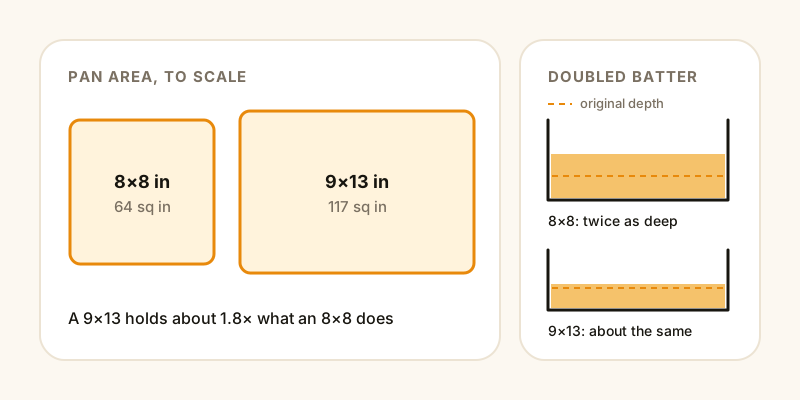
So a 9x13 is roughly 1.8 times an 8x8. That's close enough to double that most people use it for a doubled brownie or casserole recipe. It will just come out a little thicker and need a few extra minutes. When halving, a 9x13 recipe goes nicely into an 8x8.
Cooking time and temperature
Don't change the oven temperature. The temperature is what sets the browning and the structure; scaling the recipe doesn't change that.
Time is a different story, and it follows depth, not quantity. Two pans of brownies take about as long as one, because each pan is the same depth as before. One deeper pan takes longer. A doubled stew takes longer to come up to a simmer, but once it's there, the cooking time is roughly the same.
The rule: start checking at the original time and use the usual signs. Toothpick, internal temperature, a wobble in the center. Trust those over the clock.
Liquids and evaporation
Liquids reduce based on surface area, not volume. If you double a sauce and cook it in a wide pan, it can reduce faster than you expect. If you double it in a tall, narrow pot, it may take much longer to thicken. Go easy on the extra liquid at first and add more as it cooks.
Baking: leavening and yeast
Baking is chemistry, so it's less forgiving. For cookies, scaling everything straight up usually works fine. For cakes and quick breads, the reliable way to double is to make the batter as written times two, then divide it between two pans the original size, so the depth (and the rise) stays the same as the original. If your mixer bowl can't hold a double batch, make two separate batches.
Yeast doughs generally scale well at home kitchen quantities, but a larger dough can rise at a different pace. Watch the dough, not the clock: it's ready when it has doubled in size, however long that takes.
Weigh it if you can
If you bake often, a kitchen scale is the single best tool for scaling. Multiplying 250 g of flour by 1.5 is easy. Multiplying "1 cup plus 2 tablespoons" by 1.5 is not. For reference, 1 cup of all-purpose flour is roughly 120–125 g, 1 cup of granulated sugar is about 200 g, and 1 tablespoon of butter is about 14 g. Grams also remove the scoop-versus-spoon problem, where a packed cup of flour can weigh noticeably more than a spooned one.
Scaling for the week, not just the meal
Doubling dinner on Sunday so Tuesday is leftovers is half of weekly meal planning. The annoying part is getting the scaled amounts onto your shopping list correctly.
That's the bit we built CookinBuddy to handle. Every recipe has a servings control. Change it and the ingredient list rescales, and when you add the recipe to your week, the grocery list uses the scaled amounts rather than the originals. You still need to taste the salt and pick the right pan. The app is free to download on iPhone.
The short version
- Divide servings wanted by servings given. That's your factor.
- Multiply every ingredient by it, using the cheat sheet for awkward amounts.
- Scale seasoning cautiously and taste.
- Match the pan to the new volume so the depth stays similar.
- Keep the temperature, and judge doneness by how it looks and feels, not by the timer.
Other questions
- How do I double a recipe for baking?
- Multiply every ingredient by 2, ideally by weight in grams. The safest way to bake it is in two pans the size the recipe calls for, at the original temperature and roughly the original time, rather than one deeper pan.
- How do you halve an egg?
- Crack the egg into a bowl, whisk it until the white and yolk are fully combined, then use half. A large egg is about 50 g out of the shell, so half is about 25 g, or roughly 1½ tablespoons.
- Does cooking time change when you double a recipe?
- Sometimes. If the food ends up deeper in the pan or pot, it takes longer to cook through, so start checking at the original time and keep going. If you split it across two pans of the original size, the time stays about the same.
- How do I scale a recipe by portion size instead of number of servings?
- Work out the total amount you want to end up with and divide it by the total the recipe makes. For example, if a recipe makes four 300 g portions (1,200 g) and you want six 250 g portions (1,500 g), the conversion factor is 1,500 ÷ 1,200 = 1.25.
- How do I convert an 8x8 pan recipe to a 9x13 pan?
- An 8x8 pan has 64 square inches of area and a 9x13 has 117, so the bigger pan holds about 1.8 times as much. Doubling the recipe slightly overfills it, so either scale by about 1.8 or double and expect a slightly thicker bake that needs a few extra minutes.
- What is a recipe conversion factor?
- It's the number you multiply every ingredient by to resize a recipe. You get it by dividing the servings you want by the servings the recipe makes.
